
Skip to content

💰 Earn Smart Points on every purchase and payout → redeem towards free prop accounts

  • Prop Firm
    • Prop Guide
    • How It Works: Prop Explained
  • Rewards
  • Marketplace
  • Resources
    • Future Resources
      • Introduction To Futures Trading
      • Do’s & Don’ts
  • Trading Tools
    • Trade Copier
  • Contact
  • Prop Firm
    • Prop Guide
    • How It Works: Prop Explained
  • Rewards
  • Marketplace
  • Resources
    • Future Resources
      • Introduction To Futures Trading
      • Do’s & Don’ts
  • Trading Tools
    • Trade Copier
  • Contact
Sign Up / Login
  • Prop Firm
    • Prop Guide
    • How It Works: Prop Explained
  • Rewards
  • Marketplace
  • Resources
    • Future Resources
      • Introduction To Futures Trading
      • Do’s & Don’ts
  • Trading Tools
    • Trade Copier
  • Contact
  • Login
  • Prop Firm
    • Prop Guide
    • How It Works: Prop Explained
  • Rewards
  • Marketplace
  • Resources
    • Future Resources
      • Introduction To Futures Trading
      • Do’s & Don’ts
  • Trading Tools
    • Trade Copier
  • Contact
  • Login

Introduction To Futures Trading

Welcome to the dynamic world of futures trading, where financial markets come alive with opportunities for both hedgers and speculators. In this introduction guide, we’ll delve into the exciting realm of futures trading, with a specific focus on mini futures contracts. These smaller-sized contracts offer a gateway for individual investors to participate in the market’s movements without the hefty financial commitment required by standard contracts.
  1. What Are Futures?
  • Definition: Futures are financial contracts that obligate the buyer to purchase or the seller to sell an asset at a predetermined price on a specified future date.
  • Underlying Assets: Futures contracts can be based on commodities (e.g., gold, oil), financial instruments (e.g., stock indices, interest rates), or other assets.

  1. Key Participants in Futures Trading:
  • Hedgers: Individuals or businesses seeking to mitigate the risk of price fluctuations in the underlying asset.
  • Speculators: Traders aiming to profit from price movements without a direct interest in the underlying asset.

  1. Mini Futures Contracts:
  • Definition: Mini futures contracts are scaled-down versions of standard futures contracts. They have smaller contract sizes, which makes them more affordable for individual investors.
  • Contract Size: The contract size of a mini futures contract is typically a fraction of the standard contract size. For example, if the standard S&P 500 E-mini futures contract represents a smaller portion of the S&P 500 index compared to the full-size contract.
  • Leverage: Mini futures contracts still often involve leverage, allowing traders to control a larger position with a smaller amount of capital.

  1. Futures Contract Specifications:
  • Contract Size: The standardized quantity of the underlying asset in each contract.
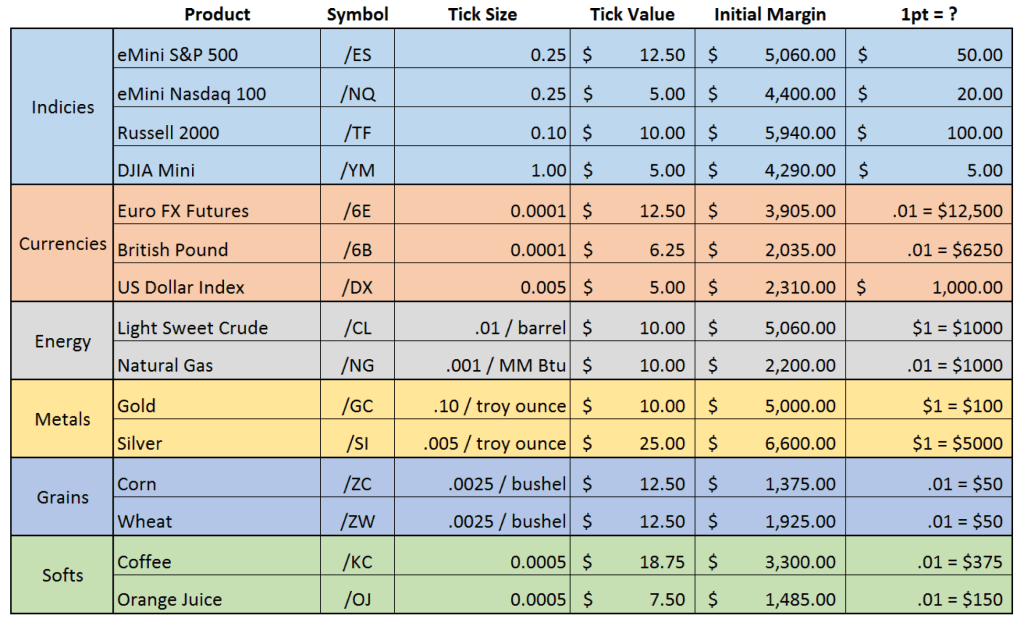
  • Tick Size and Value: The minimum price movement and its monetary value.

  1. Long and Short Positions:
  • Long Position: Buying a futures contract, anticipating that the price will rise.
  • Short Position: Selling a futures contract, anticipating that the price will fall.

  1. Leverage:
  • Futures trading involves using leverage, allowing traders to control a larger position with a smaller amount of capital. While it magnifies potential profits, it also increases the risk of significant losses.

  1. Margin Requirements:
  • Initial margin is the amount of money needed to open a futures position.
  • Maintenance margin is the minimum amount required to keep the position open.

  1. Marking to Market:
  • Daily settlement of gains and losses to ensure both parties have enough margin. Profits and losses are realized daily.

  1. Risk Management:
  • Implement risk management strategies such as stop-loss orders to limit potential losses.
  • Diversify your portfolio to spread risk.

  1. Order Types:
  • Market Order: Executes a trade at the current market price.
  • Limit Order: Specifies a price at which you want to enter or exit a position.
  • Stop Order: Triggers a market order when the price reaches a specified level.

  1. Futures Exchanges:
  • Contracts are traded on organized exchanges (e.g., CME Group, Eurex) with standardized terms to ensure transparency and liquidity.

  1. Role of Brokers:
  • Choose a reputable futures broker to execute trades on your behalf.
  • Understand the fee structure, including commissions and other charges.

  1. Popular Futures Contracts:
  • E-mini S&P 500: Based on the S&P 500 stock index.
  • Crude Oil Futures: Tied to the price of crude oil.
  • Gold Futures: Reflect the price of gold.

Advantages of Mini Futures Trading:

  • Affordability: Mini contracts make futures trading accessible to a broader audience by requiring less capital compared to their full-sized counterparts.
  • Diversification: Investors can diversify their portfolios by incorporating different mini futures contracts, gaining exposure to various asset classes without a substantial financial commitment.
  • Risk Management: Like standard futures contracts, minis enable participants to manage risk effectively. This is especially valuable for hedgers looking to protect themselves against adverse price movements.
  • Liquidity: Many mini futures contracts are actively traded on established exchanges, ensuring liquidity and ease of execution for market participants.


Conclusion:

Futures trading can be a powerful tool for managing risk and achieving financial goals. However, it comes with inherent risks, and beginners should approach it with caution. Continuous education, risk management, and a disciplined approach are key to success in the dynamic world of futures trading. Always start small, gain experience, and gradually increase your exposure as you become more confident in your trading abilities.

Disclaimer: Smart Prop Firm provides educational content and showcases future prop firm deals. We do not offer financial advice, and all trading involves risk. Rebates are subject to verification and are not guaranteed. See our Terms & Conditions and Privacy Policy for details.

©2026 Smart Prop Firm. All rights reserved

Terms & Conditions

Privacy Policy & Disclaimer


Loading Comments...