
TakeProfitTrader has introduced Pro+ Development as a stricter version of its live-funded Pro+ environment.
The main change is simple: traders in Pro+ Development face tighter risk controls — namely, reduced contract sizing, a Daily Loss Limit, and lower End-of-Day drawdown levels. The program is meant to enforce better risk management in cases where stricter controls are needed.
How It Works
Pro+ Development is not just a separate route into live funding. TPT can move traders from regular Pro+ into Pro+ Development at its own discretion when a trader's risk profile calls for tighter limits.
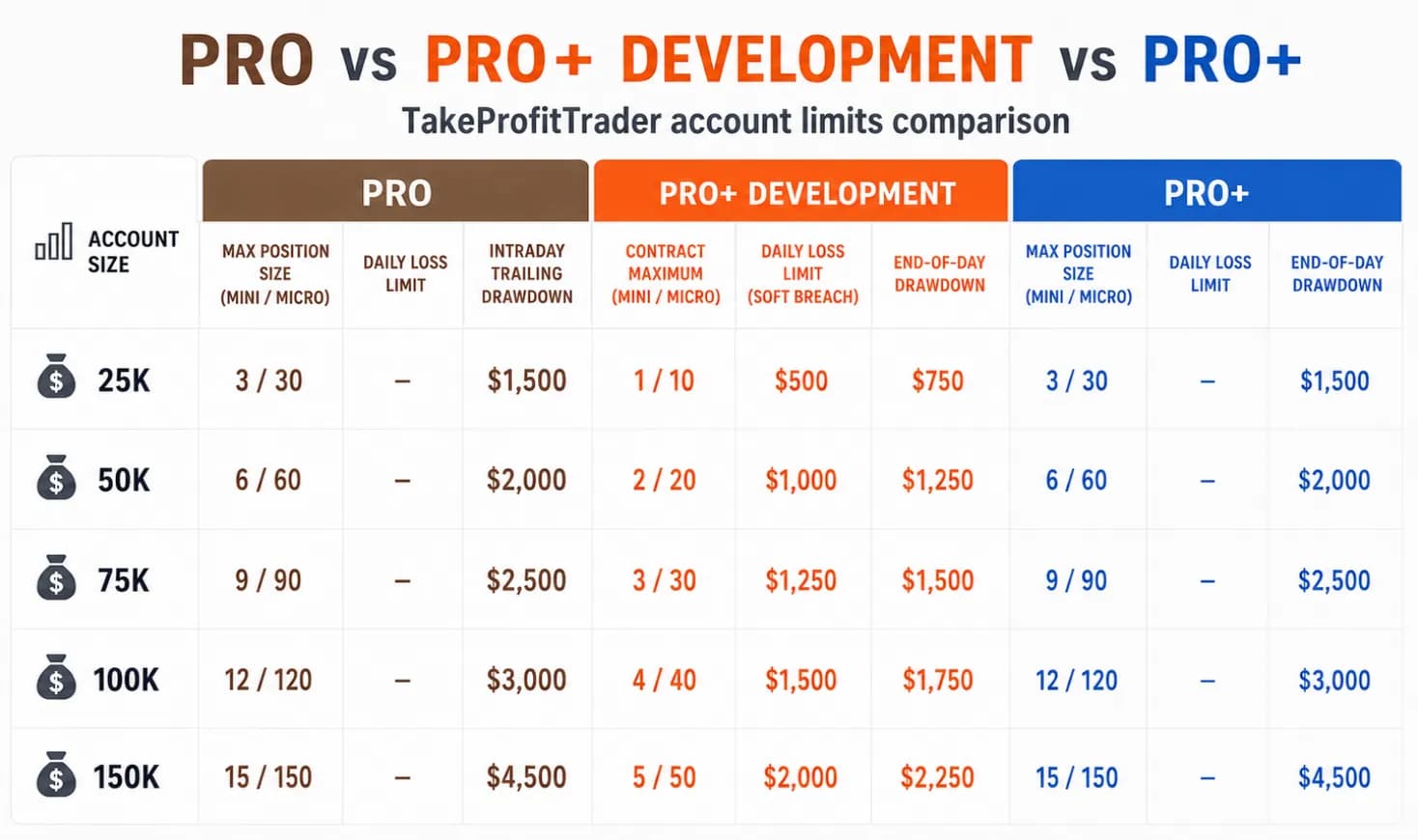
Compared with regular Pro+, the main change is reduced available contract size and drawdown room. Pro+ Development uses the same End-of-Day drawdown logic as Pro+, but also introduces a Daily Loss Limit as a soft breach, while Pro and Pro+ have none. The size reduction is substantial — for example, the 50K account goes from 6 minis in regular Pro+ to 2 minis in Pro+ Development. The drawdown limitation is serious as well, 38–50% across all plans, and the new Daily Loss Limit effectively reduces your available drawdown even more.
| Account Size | Contract Max (Mini / Micro) | Daily Loss Limit (soft breach) | End-of-Day Drawdown |
|---|---|---|---|
| $25K | 1 / 10 | $500 | $750 |
| $50K | 2 / 20 | $1,000 | $1,250 |
| $75K | 3 / 30 | $1,250 | $1,500 |
| $100K | 4 / 40 | $1,500 | $1,750 |
| $150K | 5 / 50 | $2,000 | $2,250 |
Here is how it lands in the TPT offer portfolio:
What Traders Should Know
A trader is not moved to Pro+ Development because of one bad trade alone. Placement is based on a broader review of trading history across Pro and Pro+ accounts — specifically performance, strategy, and risk behavior over time.
The stated triggers include:
- Aggressive sizing
- Fast drawdowns
- Loss limit breaches
- Reckless risk taking
- Large single-session losses
This is where discretion comes in. There is no fixed public formula that says exactly when a trader is moved. Two traders can have similar losses and still receive different treatment if TPT sees their broader risk profiles differently.
Moving back to regular Pro+ is also discretionary, but TPT gives a rough benchmark: about 60 days of consistent, disciplined risk management before moving a trader back. That does not mean hitting a specific profit number — TPT wants better risk behavior: appropriate size, controlled drawdowns, and signs that the trader can manage live capital responsibly.
Flagged Incorrectly? Need a Review?
Send your User ID and relevant context to TPT Pro+ Development support (development@takeprofittrader.com). While the review is pending, you can continue trading your tests and Pro+ Development accounts. Reviews take time, and TPT will follow up when ready.
This Is Not a Direct Punishment
Let's not lose perspective:
- The trader still operates live capital.
- Daily payouts remain on the standard 90/10 split, with no added withdrawal restrictions.
- The new Daily Loss Limit is a soft breach — deactivation for the day, not account closure. (A DLL can actually help those who struggle with overtrading and loss control.)
TPT says the goal is to stop one bad session from turning into a larger account problem. Trading live capital is different from trading simulated accounts: repeated aggressive risk behavior creates real downside for both the firm and the trader. TPT funds traders with live capital, and the firm's continued ability to do so directly affects each trader's account longevity. The Pro+ Development structure is meant to slow traders down before one bad session damages the account or the firm's capital exposure.
So What Does Pro+ Development Actually Change?
The obvious difference is a stricter approach to risk for identified traders.
But there is also a structural change: regular Pro+ is the normal live-funded setup with clear criteria, while Pro+ Development functions more like a control layer — TPT decides who enters it and who leaves it. The idea is that not every trader should be managed under the same risk limits, and that tighter controls may be necessary for a subset of live-funded traders.
TPT also says very few traders are expected to be affected. In that framing, Pro+ Development is a targeted tool, not a broad reset of the live-funded model. And it is not a verdict — traders who demonstrate corrected, more sustainable risk management are supposed to be moved back to Pro+. There's no reason TPT wouldn't want to keep working with profitable traders who have the discipline to match live trading conditions.
How Traders Are Reacting
Reactions have been mixed.
Some traders think the logic is fair. If a live-funded trader is pushing risk too hard, tighter guardrails are not an unreasonable response.
Others are more skeptical. The main concern is discretion. Since TPT decides when a trader is moved into Pro+ Development and when that trader can move back, some see the program as a possible blanket throttling tool rather than a narrowly used safeguard. The biggest issue is uncertainty around how widely those rules may be applied.
Bottom Line
Pro+ Development gives TPT a way to temporarily impose tighter live-trading limits at its own discretion. After a period (60 days is the stated benchmark), there should be a review of whether the affected trader's corrected risk management warrants a return to Pro+.
How it will be used remains to be seen — enforcement is the real test. If TPT applies Pro+ Development narrowly and explains placements clearly, it may be accepted as a live-capital risk tool. If placements feel broad or unclear, traders may see it as a discretionary throttle on Pro+ accounts.
Source: TPT — PRO+ Development Accounts