
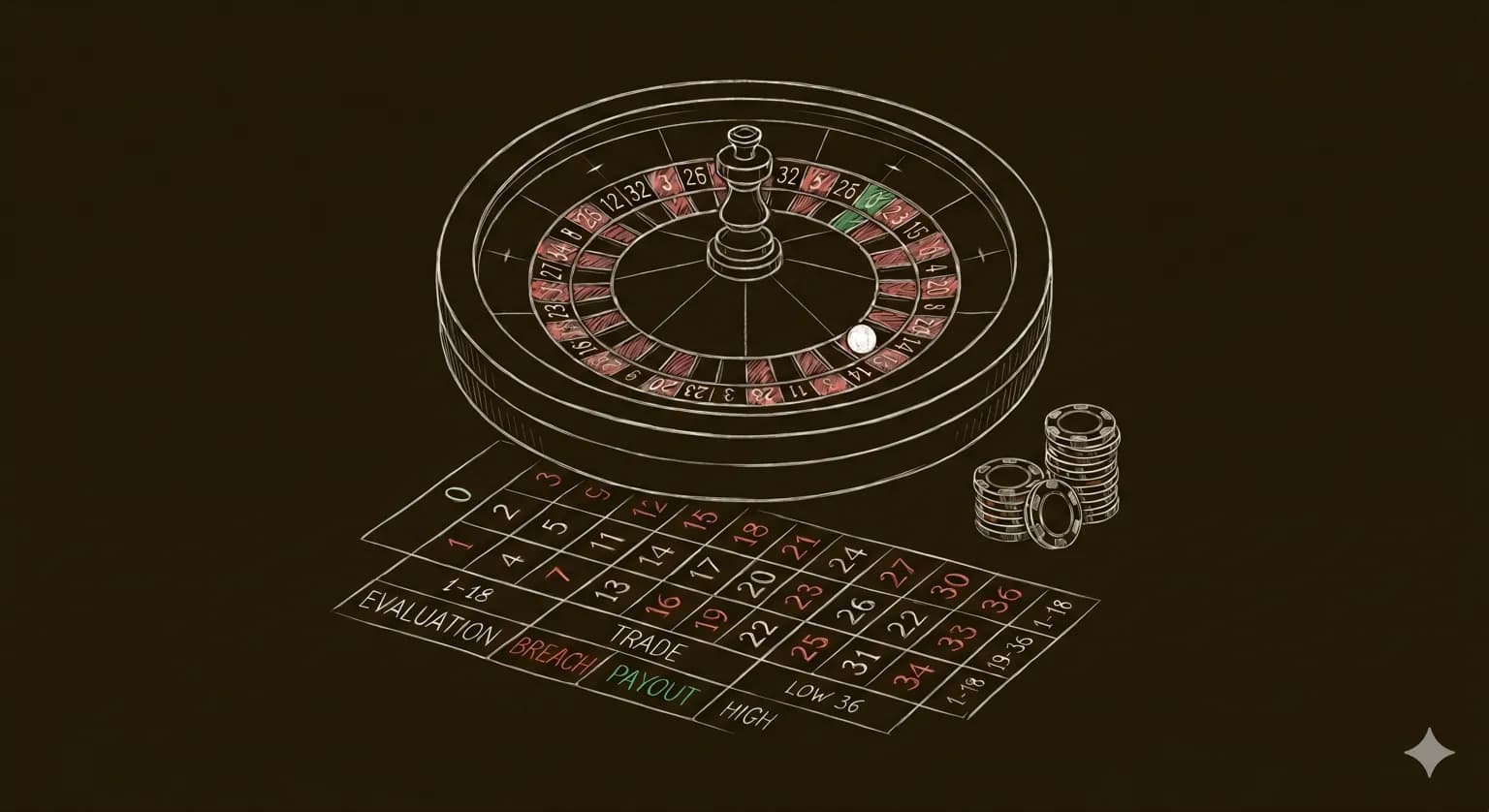
Honestly, are these prop firm people on crack? I'm gonna buy one cheap account and rinse them hard!
Not so fast, champion. Let's break down how they operate and see if their business model is able to contain a prodigy like you.
Looks suspicious — because it kinda is
If you've been around prop firms for more than five minutes, you've probably had the same thought: this feels too easy.
Pay a small fee, get access to a big "funded" account, pass a challenge, withdraw money. Meanwhile, payout screenshots are everywhere, and discounts never seem to end.
So naturally: who's paying for all this? Not who you think.
It's not a trading business — it just wears the outfit
Here's the part people miss. Prop firms aren't really in the business of trading markets. They run a very clean probability machine, packaged as a trading opportunity. They need a large group of traders moving through a system where only a small percentage makes it through consistently.
This is a fantastic business. Forget markets — imagine you have an endless stream of customers in whatever field, and the absolute majority of them pays but receives nothing in return. Many of them will just keep paying.
The flow looks like this:
- People sign up and pay for an evaluation
- Most don't pass
- Some pass, get "funded"
- Very few actually withdraw
- Very very few keep doing it for long
That gap between "a lot of people trying" and "a few people succeeding" pays for everything.
The rules? Yeah, those are doing a lot of work
At first glance, the rules feel annoying but reasonable. Daily loss limits, trailing drawdowns, consistency rules — standard stuff.
But those rules are not arbitrary. They sit exactly where traders tend to lose control. Not theoretically. Statistically.
- Right after a drawdown? Risk goes up.
- Close to a payout target? Discipline goes down.
- Trailing drawdown tightening? Decision-making gets weird.
None of this is rare — it's all predictable. And prop firms have seen it play out across thousands of accounts. The system isn't really testing if you can trade. It's testing if you can behave when things get slightly uncomfortable. That's a much smaller group.
The path feels tight because it is
A lot of traders can make money on a good day. Or a good week. Or when nothing stressful is happening.
Now add constraints:
- You can't lose more than X today
- You can't dip below Y overall
- You need to hit Z without doing anything stupid
Suddenly it's not about entries anymore. It's about not tripping over your own feet. And that's where most people get filtered out:
- They size up after a loss
- They rush trades near the finish line
- They break small rules that snowball
Nothing dramatic. Just enough friction to knock them out over time.
Plus, "funded" is not funded
As you know, not every funded trader is out there moving real money in live markets. Most accounts are simulated. Firms watch what you do, how consistent you are, whether you can not implode. Only then do they even think about putting real capital behind you.
So when payouts happen early on, they are coming from the business itself. Which, again, is fine — because the business isn't built on trading profits in the first place.
Those big payouts? Real — but not common
Yes, people get paid. Some get paid a lot. But zoom out a bit. For every trader posting a $20K withdrawal, there's a long tail of:
- Failed attempts
- Reset fees
- People who almost made it, then didn't
- People who did make it once… and never again
The visible winners are real. They're just not representative. A crowd of inconsistent ones funds the whole operation without even noticing.
The model works because traders are traders
Listen, this is not a scam. Prop firms don't even need to trick anyone. They just need to let traders be traders.
Overconfidence shows up on its own. Tilt shows up on its own. The urge to "just make it back" shows up right on schedule. The prop structure doesn't create these things — it just gives them a stage.
It's basically trading, just flipped around
Here's the funny part: the prop firm model works the same way trading does. On the surface, the odds don't look great. But both systems work if you approach them properly.
Traders survive by cutting obvious mistakes and sticking to process. Prop firms survive by designing rules around obvious mistakes and letting the process run.
Same ingredients. Different side of the table. And underneath all the noise — discounts, payouts, leaderboards — it's just math doing its job. Nothing fancy. Just well-placed pressure and a large enough sample size.