
E8 Markets is a US-based simulated trading firm that launched in 2021, running three active markets — Forex/CFD, Futures, and Crypto — built around core products like E8 One, E8 Pro, E8 Signature, and now E8 Zero. E8 Zero was introduced to remove the consistency rule.
E8 Zero went live on July 6, 2026. At the challenge stage it set a 6% profit target on closed trades, with no minimum trading days and no time limit, though an account needed at least one trade every 60 days to stay active. In place of a trailing drawdown, it applied a 3% static loss limit tied to the starting balance — one the firm said would not move except once a first payout had been processed.
Just over a week later, on July 14, E8 split the single E8 Zero product into two versions: E8 Zero Starter and E8 Zero Max — a move we'll break down in the next section, along with how the current two-tier structure works.
How E8 Zero Starter and Max Work Today
Both versions of E8 Zero run on identical rules; the split is a pricing and payout-cap distinction, not a mechanical one. Starter costs less and caps payouts lower, while Max costs more and pays out more per request. Everything else — from drawdown to consistency requirements to trading hours — applies equally across both.
The challenge stage carries no minimum trading days and no time limit, only a requirement to place and close at least one trade every 7 days to keep the account active. The drawdown moves with the account's highest end-of-day balance but only updates once per day at market close, so intraday swings don't touch it.
The challenge is also where the only consistency requirement in the entire program lives: a 40% Best Day rule, meaning no single day can account for more than 40% of total profits generated. Because of how that rule works mechanically, the fastest a trader can clear the challenge is 3 trading days.
Pricing
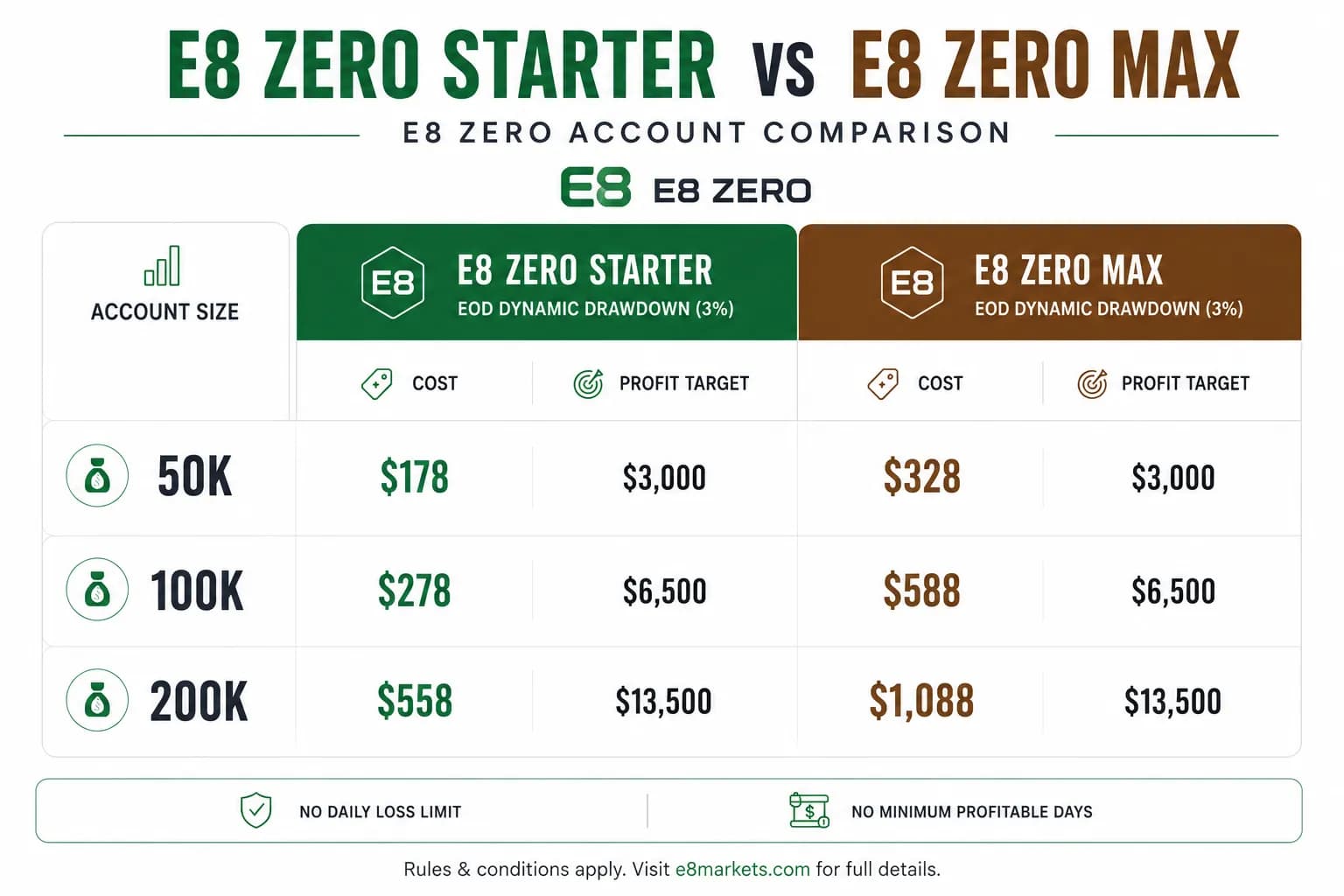
At $50K, Max costs roughly 84% more than Starter. At $200K, Max costs almost twice as much as Starter outright — the gap nearly doubles in dollar terms between the smallest and largest account sizes.
Readers using SmartPropFirm's code SMART at checkout receive 40% off account purchases, applicable across both Starter and Max at all three sizes.
Payout Caps: The Real Difference Between Starter and Max
Payout caps are what separate Starter and Max beyond price. A cap determines the maximum amount that can be requested in a single payout, tied to account size rather than to how many payouts have already been taken, so the ceiling stays the same on every request within the five-payout cycle.
| Account Size | Starter Cap (Per Payout) | Max Cap (Per Payout) |
|---|---|---|
| $50,000 | $1,000 | $3,000 |
| $100,000 | $1,600 | $5,000 |
| $200,000 | $2,100 | $7,000 |
Each account allows a maximum of five payouts in total. Once the fifth is requested — regardless of size or aggregate amount taken — the cycle closes, the account deactivates, and the trader receives a free Challenge account of the same size to restart the process.
That five-payout ceiling is what makes the pricing gap make sense. Assuming a trader hits the cap on all five payouts, Starter tops out at $5,000 total on $50K, $8,000 on $100K, and $10,500 on $200K across a full cycle. Max, on the same assumption, tops out at $15,000, $25,000, and $35,000 respectively.
That's a $10,000 gap at $50K for a $150 premium, and a $24,500 gap at $200K for a $530 premium — a spread that grows far faster than the price difference does. The catch is that this only plays out for traders generating enough profit to hit the cap each cycle; a trader who never approaches the payout ceiling gets little practical benefit from Max over Starter beyond a larger buffer.
Profit Split
E8 Zero's default payout share is 80%, the standard configuration at checkout for both Starter and Max across all three account sizes. Traders can upgrade to a 100% split instead, meaning the full amount of a payout request goes to the trader rather than 80% of it.
The upgrade applies the same way regardless of tier — it isn't a Starter-only or Max-only option, and it doesn't change any of the account's trading rules. Profit target, drawdown, and the 40% Best Day rule stay identical either way.
| Account Size | Starter (80%) | Starter (100%) | Max (80%) | Max (100%) |
|---|---|---|---|---|
| $50,000 | $178 | $228 | $328 | $428 |
| $100,000 | $278 | $358 | $588 | $748 |
| $200,000 | $558 | $708 | $1,088 | $1,418 |
As the table shows, the trade-off for selecting the 100% split is cost — a higher upfront fee at every account size, on both tiers. Also note, these figures are flat rates and don't include any promos or discounts.
News & Copy Trading
Since Starter and Max share identical rules, everything here applies to both tiers equally. News trading carries no restrictions on E8 Zero — on either the challenge or the performance account — which means trades can be held through high-impact releases without a blackout window. Copy trading is also permitted, but only across accounts the trader personally owns.
Bottom Line
E8 Zero launched on July 6 as a single product built around the removal of the consistency rule outside the challenge stage. Eight days later, E8 split it into Starter and Max — not by changing any of the underlying mechanics, but by introducing a pricing and payout-cap tier on top of an otherwise identical program.
The profit targets, the 40% Best Day rule, the EOD Dynamic Drawdown, and the five-payout cycle all apply the same way regardless of which tier a trader buys.
E8 hasn't published a stated reason for the split, but the practical effect works in traders' favour either way: what launched as a single, fixed program is now a choice. A trader who only wants a lower-cost entry point isn't forced into a higher payout ceiling they don't need, and a trader who expects to trade larger sizes and hit caps regularly has a tier built for that instead of a one-size-fits-all structure. On balance, that added flexibility is the clearest net positive to come out of the update.