
TradeDay, the Chicago-based futures prop firm founded in 2020 by James Thorpe and Steve Miley, didn't tweak its account lineup this year — it replaced it. On May 29, 2026, the firm retired its entire previous product line and relaunched as TradeDay 2.0, with two clear evaluation routes and a rewritten approach to how profit splits are calculated.
Quick Pay is the flexible option: traders choose between Intraday or End-of-Day (EOD) trailing drawdown at signup, with a five-day minimum trading requirement setting the pace to get funded.
Fast Pass strips that choice away in exchange for speed: evaluations can be completed in as few as three trading days, with an End-of-Day-only drawdown structure keeping the risk framework simple. The split is the point — Quick Pay for traders who want control over their risk profile and fast access to payouts once funded, and Fast Pass for traders who just want the shortest possible runway to a funded account.
How The Programs Work
Both Quick Pay and Fast Pass are offered across the same three account sizes of $50K, $100K, and $150K, so the choice isn't about how much capital you can access but about which rule set you want to trade under.
Contract limits, profit targets, and drawdown amounts are identical during evaluation at each size regardless of which route you pick; what changes between Quick Pay and Fast Pass is the drawdown structure, the split mechanics, and how fast you can get funded.
| Quick Pay | Fast Pass | |
|---|---|---|
| Contract Limit (Eval) | 5 / 10 / 15 (50K/100K/150K), or 50 micros, flat across all sizes | 5 / 10 / 15 (50K/100K/150K), or 50 micros, flat across all sizes |
| Profit Split (Funded Sim) | 50/50, then 80/20 | 80/20 |
| Profit Split (Funded Live) | 90/10 | 90/10 |
| Minimum Payout | $250 | $250 |
| Inactivity Rule | No | No |
| Minimum Trading Days (Eval) | 5 days | 3 days |
| Payout Requests | Eligible as soon as the account shows any positive profit | 5 individual profitable trading days required before a payout request (funded stage, separate from the evaluation's day requirement) |
| Consistency Rule | No single day may exceed 30% of total profit; evaluation only, lifted once funded | No single day may exceed 45% of total profit; evaluation only, lifted once funded |
Pricing at a Glance
Pricing isn't identical across the routes, even though the drawdown amounts and profit targets are. Fast Pass costs the most at every tier, and Quick Pay's Intraday option is the cheapest entry of all — here's the full breakdown at the current 50% off:
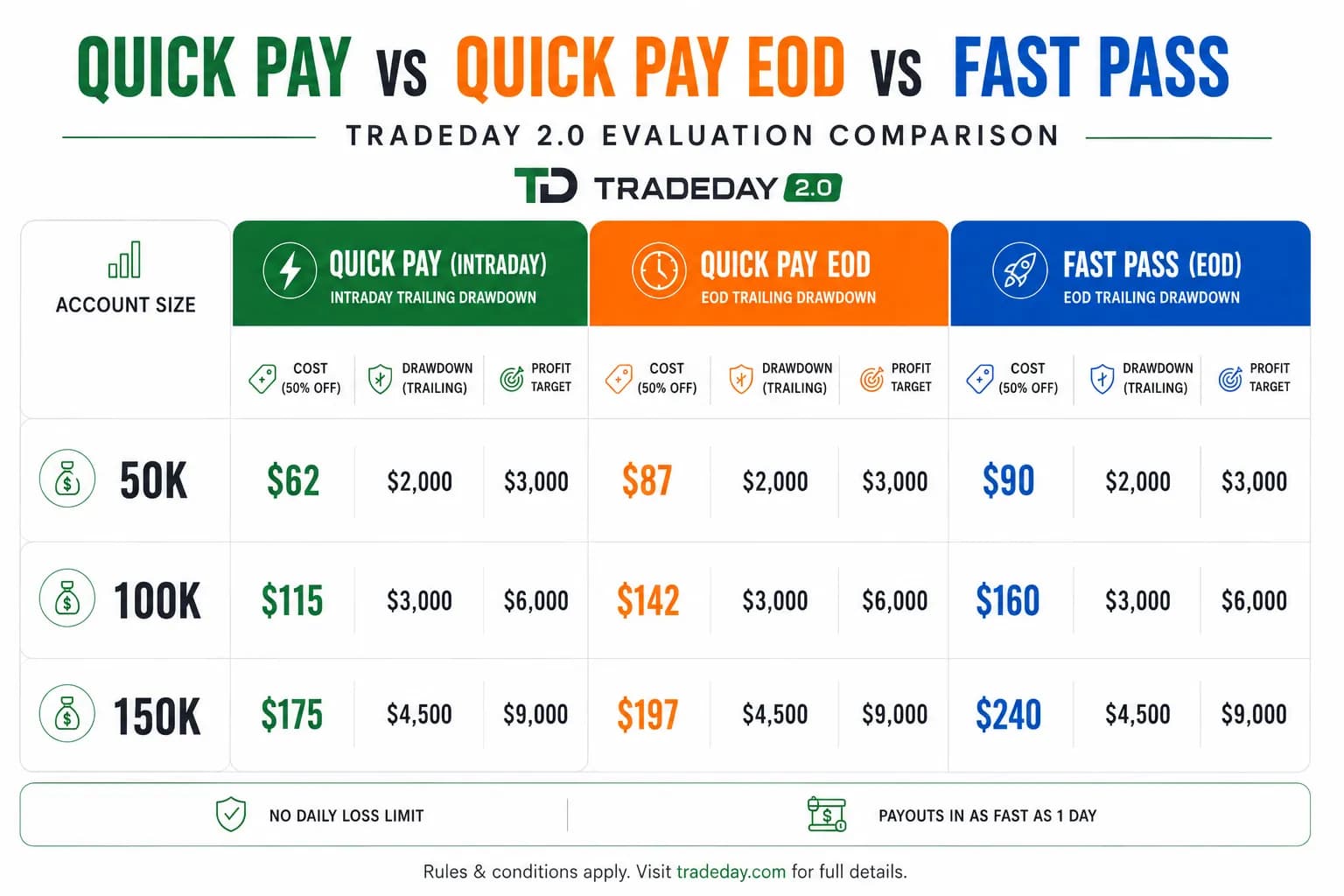
Speed to funding comes at a small but consistent premium, and choosing Intraday drawdown on Quick Pay is what unlocks the lowest price of the three.
Inactivity Rule
TradeDay itself charges no inactivity fees and sets no minimum trading requirement, so the rule isn't coming from TradeDay's side at all. That lies with the platform: Tradovate automatically archives any account that goes untouched for more than one calendar month. Once archived, the account is pulled from the trading platform permanently and can't be recovered or reactivated, by the trader or by TradeDay.
TradeDay then treats it as a failed account, meaning the only way forward is a paid reset or a new purchase. In practice, this means the real inactivity clock isn't set by TradeDay's rules but by how long you go without logging into Tradovate.
What the $250 Minimum Actually Requires
The $250 minimum payout is the same number on both routes, but what it takes to reach it isn't, because the split determines how much net profit has to exist before $250 of it is actually the trader's.
On Fast Pass, the maths stays constant: since the split is a flat 80/20 from the first dollar, a trader needs $312.50 in profit to net a $250 payout at any point.
On Quick Pay, it depends entirely on which side of the $4,000 net profit threshold the trader sits. Below it, the 50/50 split means $500 in net profit is needed to net $250, which is almost double what Fast Pass requires for the same payout.
Only once net profit clears $4,000 does the math match Fast Pass, needing just $312.50. Practically, this means a Quick Pay trader sitting on $150 or $200 in early gains isn't just below the $250 floor — they're below it by more than the raw number suggests, since half of whatever they make in that stretch goes to TradeDay before it counts toward a withdrawable balance.
Once either account moves to Funded Live and the split flattens to 90/10, the gap narrows further still: $250 requires just under $278 in net profit, the cheapest path to a payout across either program.
Drawdown Types: Evaluation vs. Funded
| Evaluation | Funded | |
|---|---|---|
| Quick Pay | Trader's choice — Intraday or EOD | EOD selections convert to Intraday; Intraday selections stay Intraday |
| Fast Pass | EOD only | EOD only — no change |
Quick Pay is the only route with a choice at signup, but that choice isn't permanent; if you pick EOD to get through the evaluation, the account switches to Intraday drawdown the moment it reaches Funded Sim. Traders who choose Intraday from the start see no change at all when they get funded.
Fast Pass never offers the choice and never changes — EOD drawdown from evaluation straight through to funded.
Position Limits: Evaluation vs. Funded
| Evaluation | Funded | |
|---|---|---|
| Quick Pay | 5 / 10 / 15 contracts (50K/100K/150K), 50 micros flat | 5 / 10 / 15 contracts (50K/100K/150K), 50 micros flat |
| Fast Pass | 5 / 10 / 15 contracts (50K/100K/150K), 50 micros flat | 2 / 3 / 4 (50K/100K/150K), scaling up by 1 contract for every $2,000 in profit |
Fast Pass funded accounts pick up one additional contract for every $2,000 in profit, but the starting point at Funded Sim is meaningfully smaller than what the trader was just running in evaluation. It's a real tradeoff sitting underneath Fast Pass's speed advantage that the contract limit line in the program overview doesn't capture on its own.
Payout Policy
Both routes share a $250 minimum payout, but qualifying for one works differently on each side.
Quick Pay Funded Sim accounts are eligible for payouts from day one, with a $250 minimum. The profit split starts at 50/50 up to the first $4,000 threshold, then moves to 80/20 above that.
Fast Pass Funded Sim accounts pay 80/20 from the start. But every payout, not just the first, requires 5 profitable trading days, scaled by account size: $150/day on 50K, $200/day on 100K, and $250/day on 150K. Payouts are also capped at 50% of the account balance, with a hard ceiling by tier: $2,000 on 50K, $2,500 on 100K, and $3,000 on 150K.
Quick Pay is the more flexible payout route. Fast Pass is faster to pass but slower and more limited to withdraw from.
Live Funded
TradeDay's bigger positioning move is the path to Funded Live, and it plays out differently depending on the route.
Quick Pay accounts are reviewed for Funded Live at $10,000 gross profit, tracked separately on each funded account. Hitting that number pauses the account for review. Most traders move to Funded Live from there, but on rare occasions, TradeDay grants an extension to keep trading Funded Sim instead.
The part worth underlining is that profit earned above $10,000 isn't simply withheld from the payout or left out of the transfer; it's removed from the account and forfeited outright. Continuing to trade past the threshold before review completes doesn't delay access to those gains but eliminates them permanently, which is why the practical move once $10,000 is hit is to stop and wait for review.
Fast Pass runs on an entirely different trigger: the 5th payout request, not a profit number. That request closes the Funded Sim account and opens a new Funded Live account at $0, carrying over the same EOD drawdown from the account's original tier.
Once live, both routes converge on the same terms. Funded Live accounts trade real markets, split 90/10 in the trader's favour, require a paid professional data feed of $156/month per exchange, and carry slippage rules that Funded Sim accounts don't.
TradeDay caps traders at 5 Funded Live accounts at once, and a trader already in the program can't keep purchasing new evaluations while holding one. Losing a Funded Live account also triggers a mandatory 3-month cooling-off period before the trader can take part in new evaluations.
What TradeDay 2.0 Offers Traders
TradeDay 2.0's real differentiator is the choice itself. On one side, Fast Pass adds speed but not unlimited freedom; on the other, Quick Pay gives faster payout access, but the path to live still has a hard review point. Funded Live brings better split terms but also real-market controls.
A few genuine positives carry over: no inactivity fee or ongoing trading minimum from TradeDay itself, and entry pricing as low as $62.50 at the 50K tier, which is the cheapest the firm has offered since launching in 2020.
What 2.0 changes isn't how hard funding is to reach. It's how much say a trader gets in choosing the terms they reach it under — the payout flexibility of Quick Pay or the passing speed of Fast Pass.